Compare fifteen proposed games with a definite stopping point: one decision, a short sequence of prompts or one compact board. Choose by reading load and task structure, not by a promise that fewer buttons means faster play. Timing and membership remain unapproved.
Editorial version: 1Content review:
Editorial estimates, not measured completion times. Typical successful completion is unmeasured. Include instructions, reading, mistakes and retries; quick losses or automated wins are not proof.
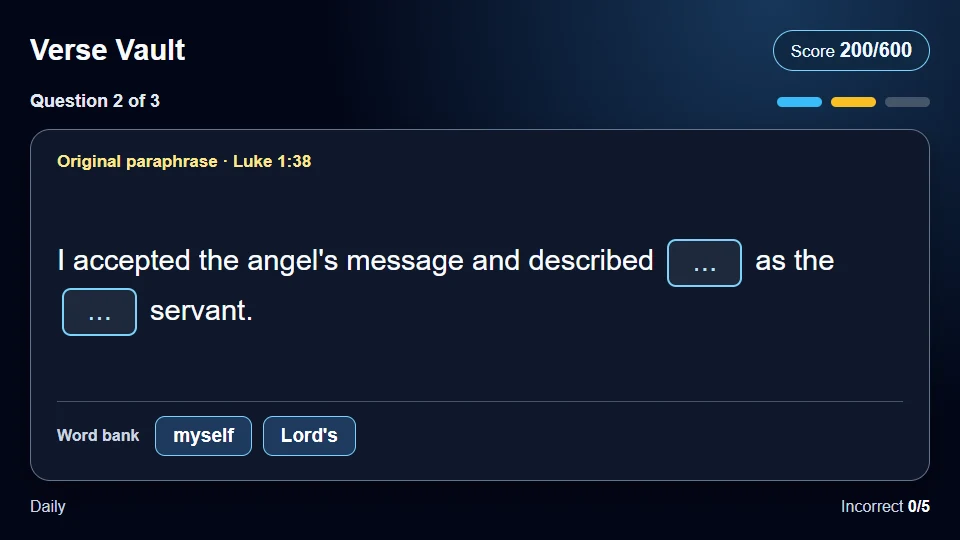
Each stage presents two words rather than requiring free-text recall, and the three-stage round has an explicit end.
Reading focus
Attend to how a supplied word fits the meaning and wording of the displayed original paraphrase.
Estimated duration
Typical successful completion is unmeasured. Include instructions, reading, mistakes and retries; quick losses or automated wins are not proof.
Source difficulty facet
Beginner
Typed input required
No
Play format
Words
Bible section
Across the Bible, Old Testament, New Testament
Source-marked group suitability, not multiplayer
No
Session format
Finish all three stages. The supplied bank is an aid, not a penalty; leave optional reading of the cited passages outside any separately recorded round time.
Source and fiction boundaries
The restored text is an original paraphrase, not a quotation from a Bible translation or proof of memorizing a verse.
Facilitator preparation
The restored text is an original paraphrase, not a quotation from a Bible translation or proof of memorizing a verse.
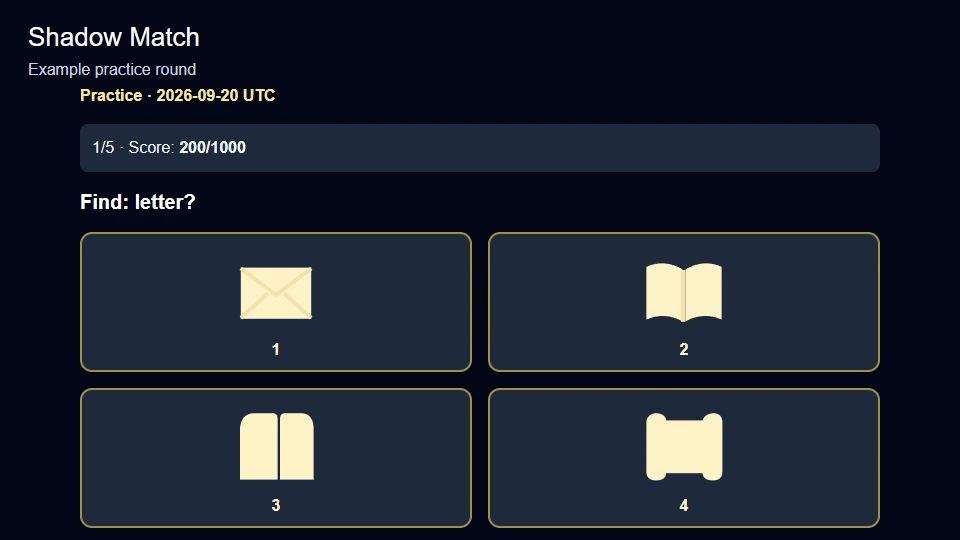
The named target and four visible choices create a repeated, bounded recognition task without a typed answer.
Reading focus
Compare a word with an object shape and read the game's source notes separately from that recognition task.
Estimated duration
Typical successful completion is unmeasured. Include instructions, reading, mistakes and retries; quick losses or automated wins are not proof.
Source difficulty facet
Moderate
Typed input required
No
Play format
Questions
Bible section
Old Testament, Gospels, New Testament
Source-marked group suitability, not multiplayer
No
Session format
Answer each of the five object prompts by choosing a silhouette numbered 1-4. The option numbers are not object-name labels; do not infer a passage meaning from decorative art.
Source and fiction boundaries
This is object recognition, not a quiz on the catalogue's Bible facts or a universal interpretation of biblical symbols.
Facilitator preparation
This is object recognition, not a quiz on the catalogue's Bible facts or a universal interpretation of biblical symbols.
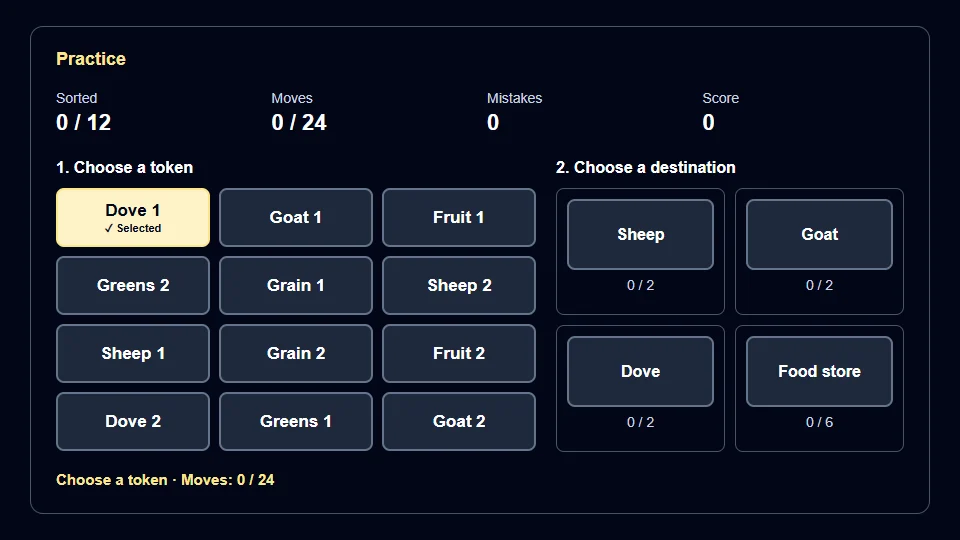
Destination labels remain visible and correct tokens lock, giving the player a finite sequence of sorting choices with a visible remaining task.
Reading focus
Read the preparation-themed labels and match the game's categories without treating its quantities as a historical inventory.
Estimated duration
Typical successful completion is unmeasured. Include instructions, reading, mistakes and retries; quick losses or automated wins are not proof.
Source difficulty facet
Beginner
Typed input required
No
Play format
Sorting
Bible section
Old Testament
Source-marked group suitability, not multiplayer
No
Session format
Read the destination labels first, then sort all twelve tokens. Incorrect destinations and retries count toward the round's move limit and observed time.
Source and fiction boundaries
The tokens, quantities and categories are examples for the puzzle, not an exact list of what was aboard Noah's ark.
Facilitator preparation
The tokens, quantities and categories are examples for the puzzle, not an exact list of what was aboard Noah's ark.
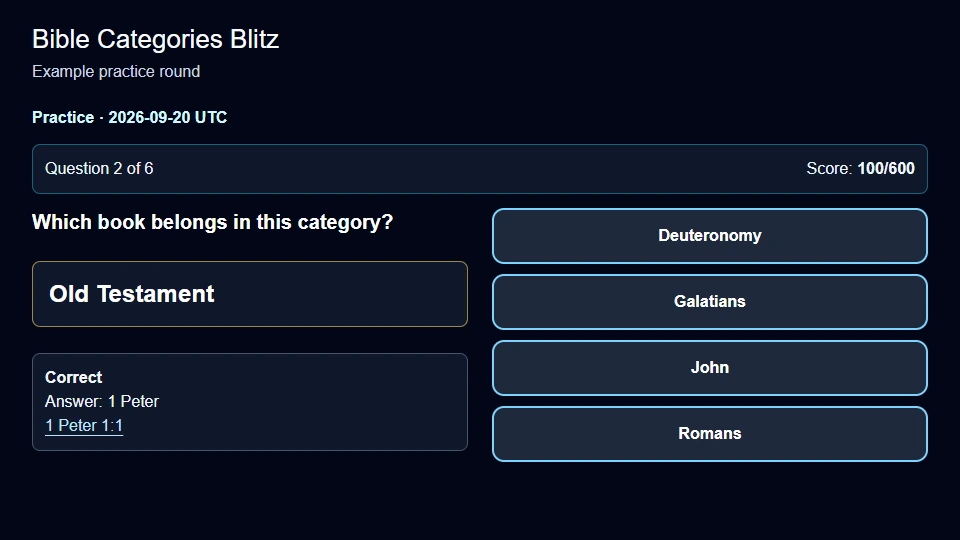
One category and a small set of book choices appear at a time, offering a contained alternative to sorting a whole bank.
Reading focus
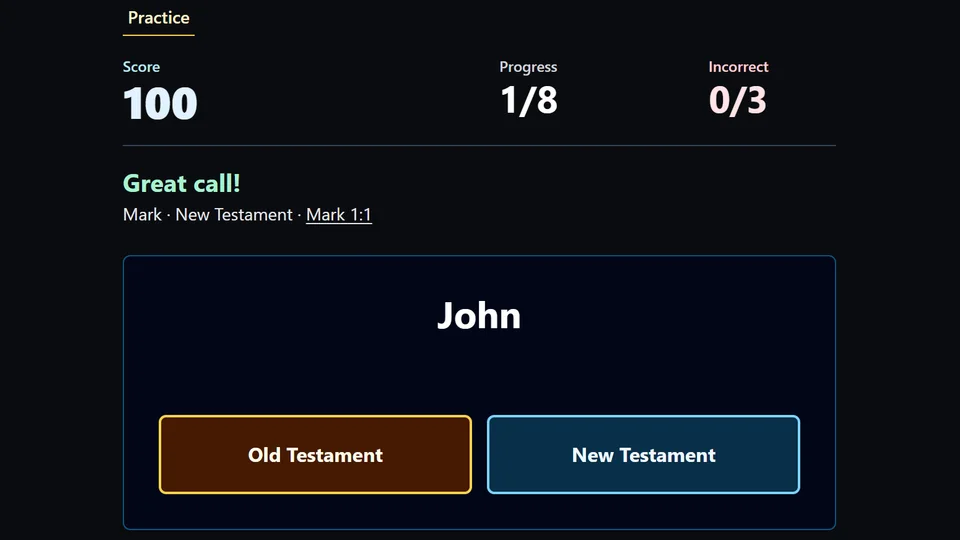
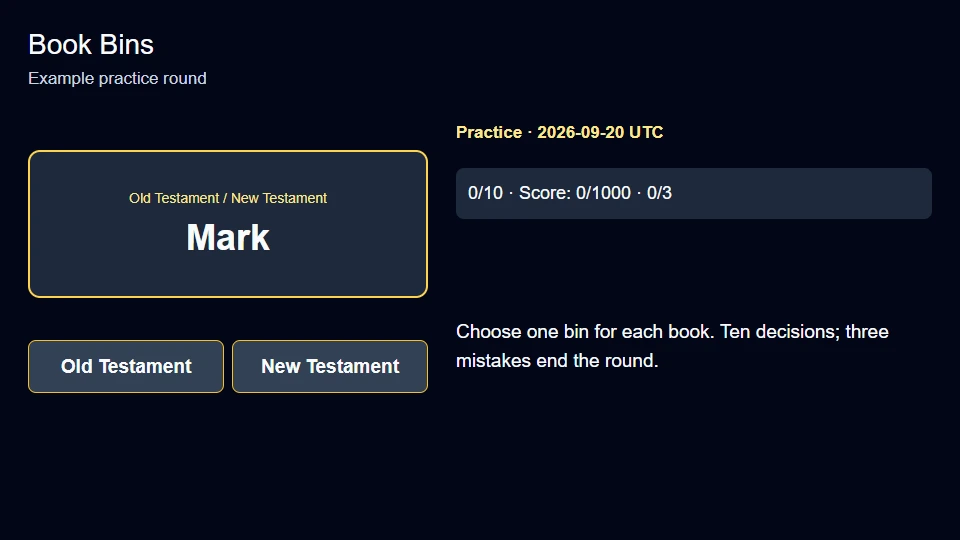
Distinguish the Testament and literature associations represented by the game's categories.
Estimated duration
Typical successful completion is unmeasured. Include instructions, reading, mistakes and retries; quick losses or automated wins are not proof.
Source difficulty facet
Moderate
Typed input required
No
Play format
Questions
Bible section
Across the Bible
Source-marked group suitability, not multiplayer
Yes
Session format
Complete the six prompts, reading the category before the options. Review the supplied references after the result without treating the score as mastery of a whole Bible book.
Source and fiction boundaries
Categories are curated teaching labels. The questions do not survey every literary feature or every Christian canon.
Facilitator preparation
Categories are curated teaching labels. The questions do not survey every literary feature or every Christian canon.
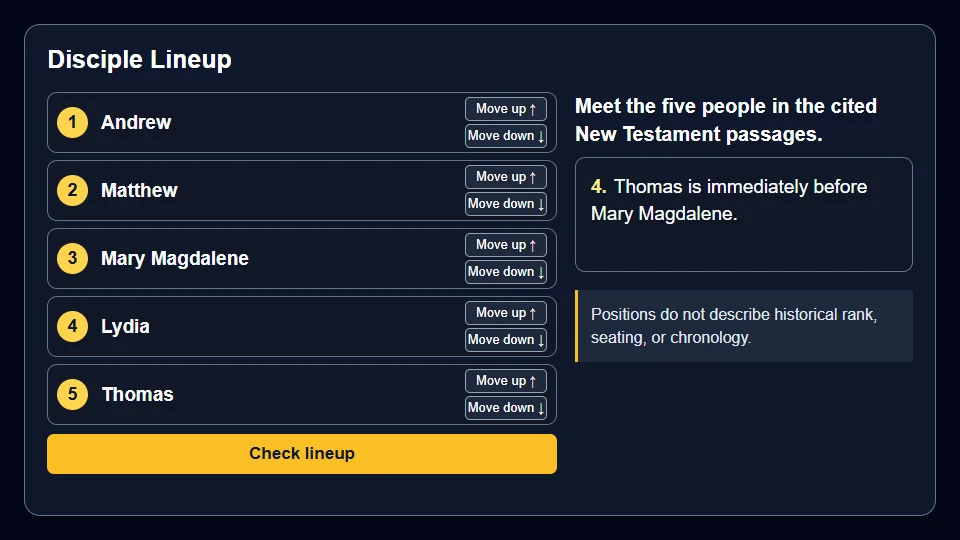
Five entries keep the board compact, while the fixed clue set lets a player plan before submitting an arrangement.
Reading focus
Separate the game's logical position clues from the accompanying source notes about each person.
Estimated duration
Typical successful completion is unmeasured. Include instructions, reading, mistakes and retries; quick losses or automated wins are not proof.
Source difficulty facet
Moderate
Typed input required
No
Play format
Sorting
Bible section
New Testament, Gospels
Source-marked group suitability, not multiplayer
No
Session format
Read all position clues, rearrange the people and submit the full lineup. Corrective submissions are part of the same session, not separate quick wins.
Source and fiction boundaries
The lineup and relative positions are invented. These five people are not presented as the complete Twelve or as a historical seating order.
Facilitator preparation
The lineup and relative positions are invented. These five people are not presented as the complete Twelve or as a historical seating order.
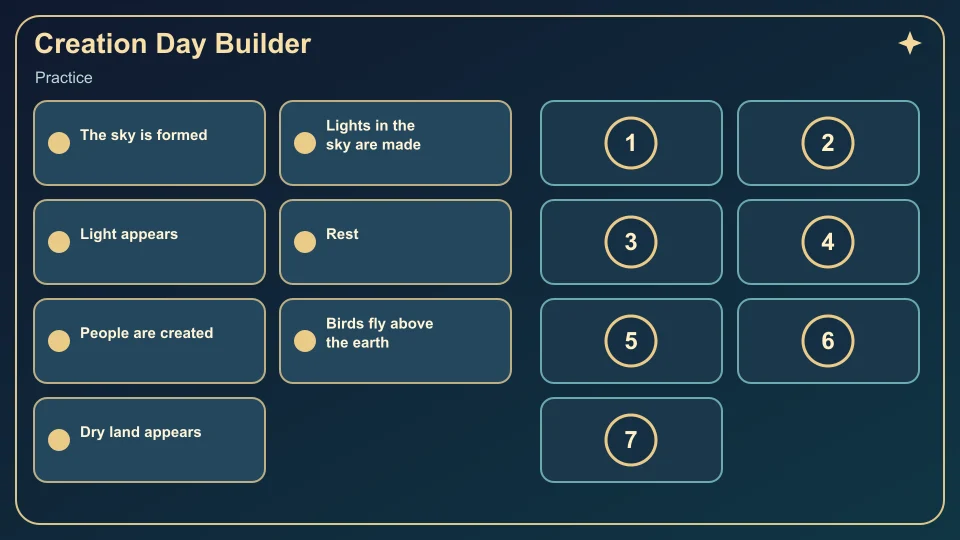
The day slots provide a bounded ordering task with a clear full-board result rather than an open-ended building simulation.
Reading focus
Attend to the written day sequence represented by the game's source account.
Estimated duration
Typical successful completion is unmeasured. Include instructions, reading, mistakes and retries; quick losses or automated wins are not proof.
Source difficulty facet
Moderate
Typed input required
No
Play format
Route planning
Bible section
Old Testament
Source-marked group suitability, not multiplayer
No
Session format
Read the current creation clue and choose its day. Each placement is graded immediately; use that feedback before the next placement and consult the source account when needed.
Source and fiction boundaries
The task follows the account's written sequence. It does not establish scientific dates, physical processes or the player's theological position.
Facilitator preparation
The task follows the account's written sequence. It does not establish scientific dates, physical processes or the player's theological position.
Selection rationale
Readers age 13 and older choosing a contained solo round. Familiarity with names, language, reference reading and controls can affect time. There is no tested classroom format, age-flow approval or first-time-player timing claim.
One complete fresh round is the comparison unit. Read its instructions and prompts, include mistakes and retries, and stop at its terminal result. Practice is a separate attempt; optional discussion or further passage reading adds untimed depth. A timed loss does not prove a typical successful completion.
These are candidates for actual timing because their tasks have explicit ends and different reading demands. Fifteen unique released game IDs establish only source-count completeness, not fifteen qualifying quick games. Existing under-five facets, source action counts, developer wins and AI/browser automation do not establish typical visitor completion.
Start with single-decision formats, continue through matching and recognition, then compare sorting and ordering. The list is not a measured fastest-to-slowest ranking, popularity list or difficulty scale.
Typical successful completion is unmeasured. Include instructions, reading, mistakes and retries; quick losses or automated wins are not proof.
Choosing a game
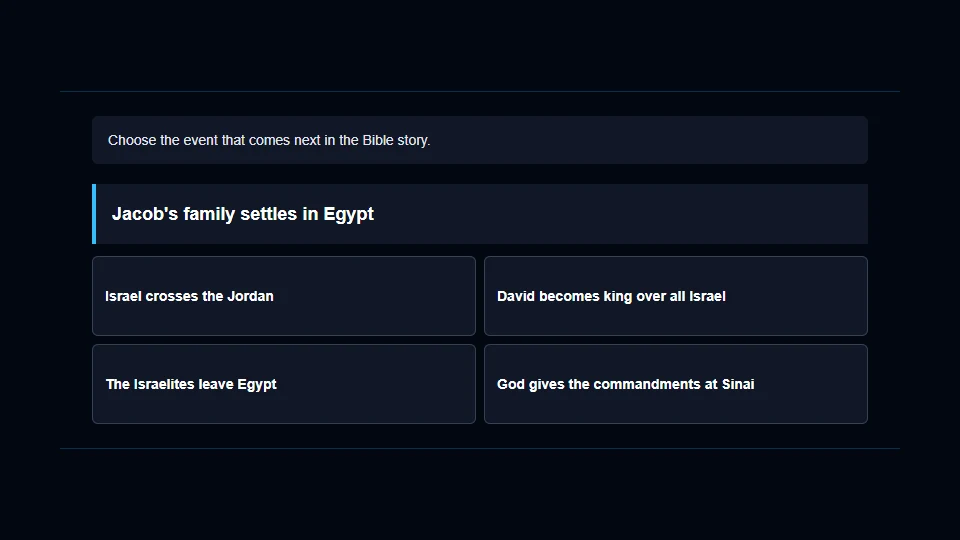
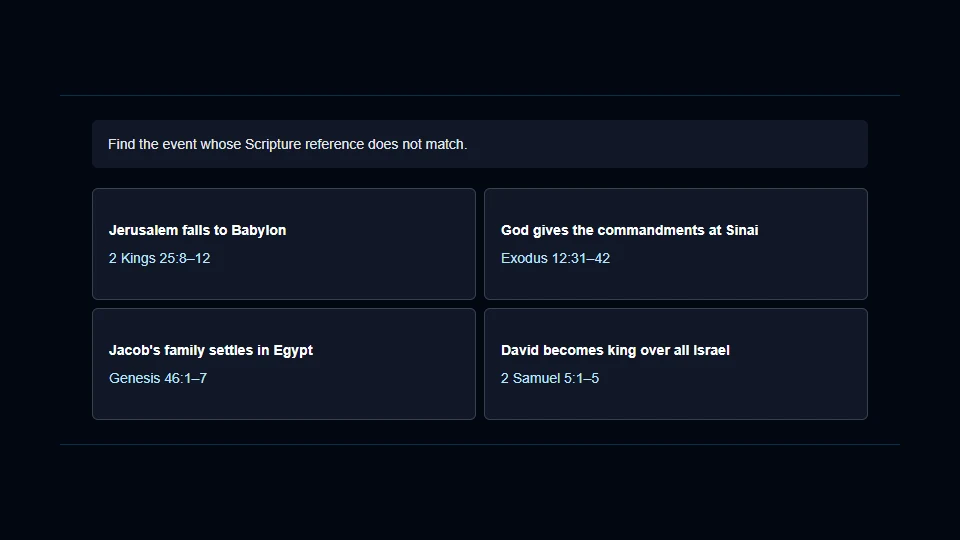
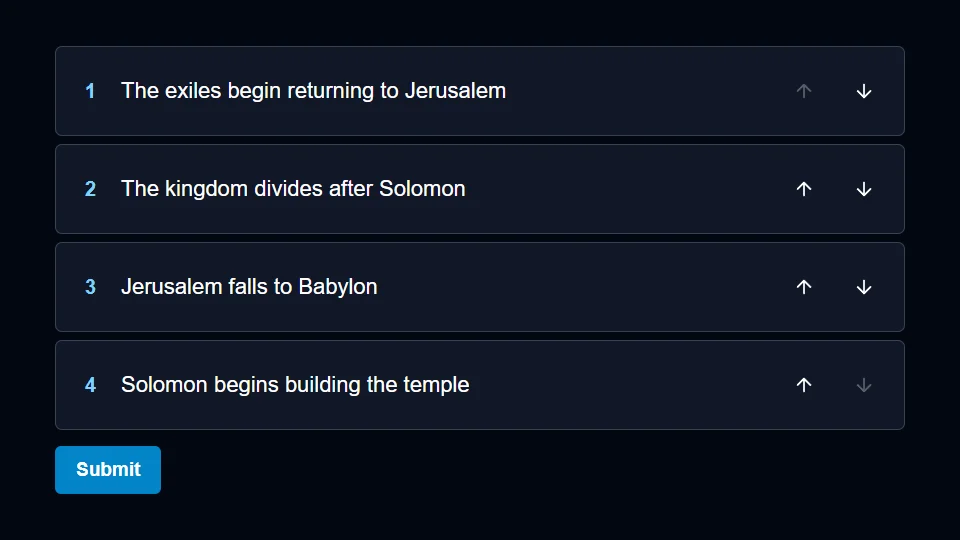
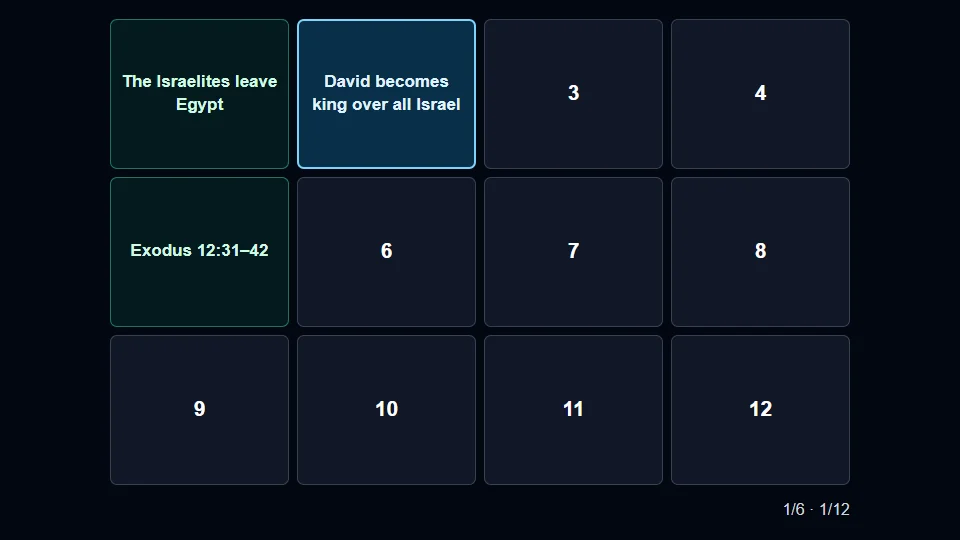
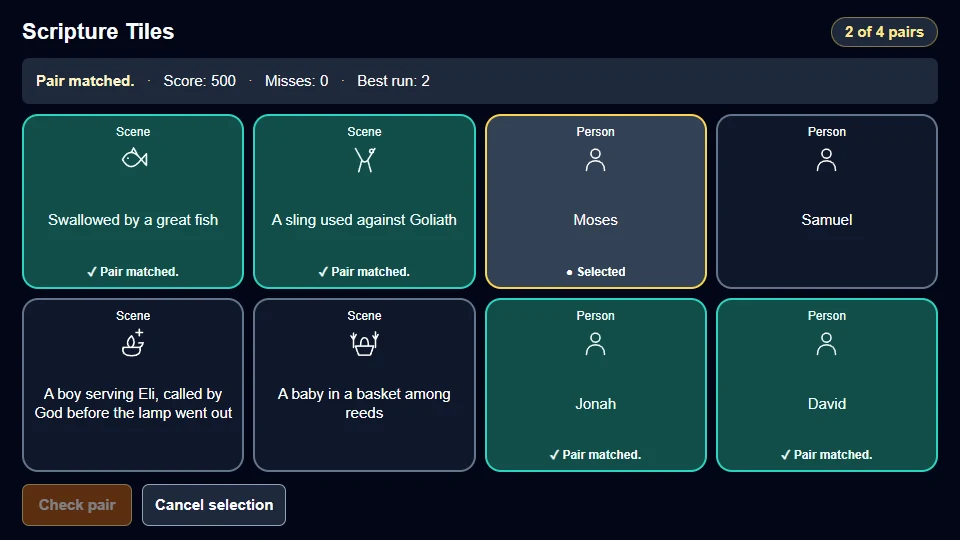
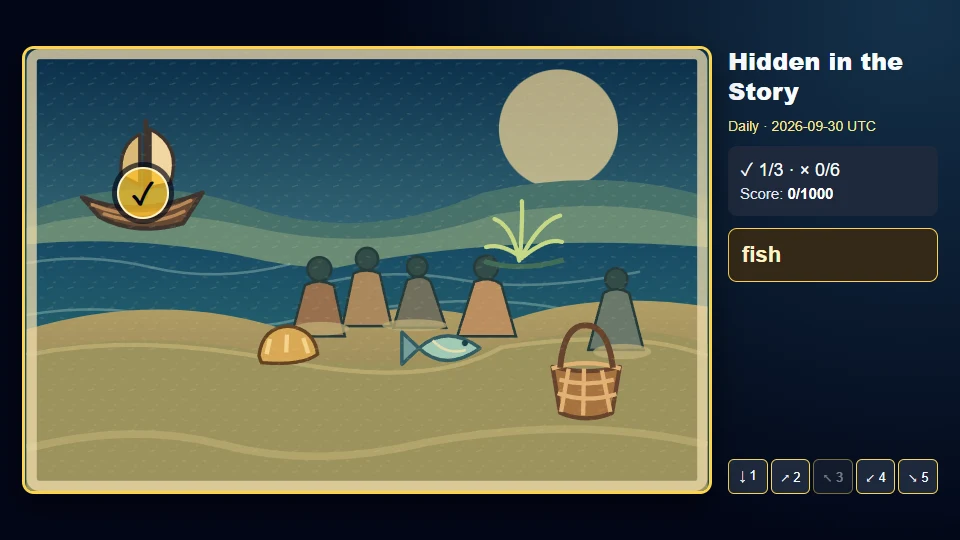
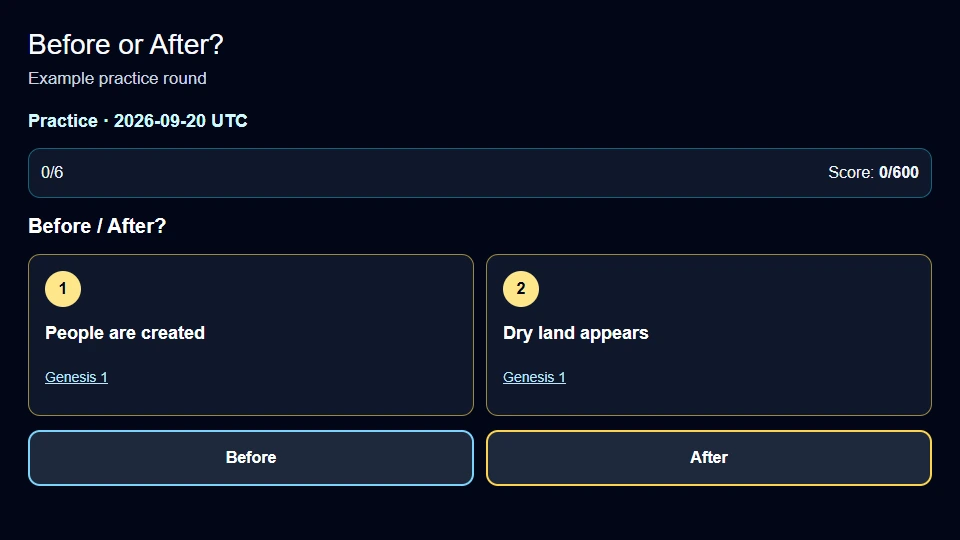
Choose What Happens Next? when one event decision suits your session. Choose Truth or Trap only when you have time to check its references; both end after one choice but ask for different reading. Choose Scripture Tiles or Bible Memory Match for pairing. Visible clue tiles and hidden-card recall are different demands, even when both boards are compact. Choose Verse Vault for supplied-word placement, Hidden in the Story for named-object search or Shadow Match for name-to-shape recognition. None requires a typed Bible quotation. Choose Testament Dash for repeated two-category decisions, Book Bins for a whole-bank sort or Bible Categories Blitz for one category prompt at a time. Read the active categories rather than judging time from the number of buttons. Choose Story Scramble, Before or After, Disciple Lineup or Creation Day Builder when ordering appeals to you. Curated event sequence, invented position logic and the written creation sequence are distinct tasks, not one historical timeline.
Are these fifteen games already verified to take five minutes?
Typical successful completion is unmeasured. Include instructions, reading, mistakes and retries; quick losses or automated wins are not proof.
What should a completion-time observation include?
Record a real completed round with its language, mode, instructions, reading, accepted actions, mistakes, retries and result. Keep interruptions and optional further study explicit. Never count a fast failed attempt or an automated known-answer run as typical successful play.
Should I rush to get a game point or badge?
No. Points and badges follow the game's server-owned completion rules, not a collection stopwatch. Repeating an already credited game does not add another game point, and a score is not a measure of faith or lasting Bible knowledge.