W.W.J.D. Chat logo
W.W.J.D.
Chat
All Bible games

6 Bible Games About Jesus and the Gospels

These six games use Gospel objects, miracle contexts, parable steps, passage questions, parallel references and a parable-led layout. Compare what the task actually asks rather than treating every sheep, boat or lamp as a new Gospel subject.

Editorial version: 1Content review:

Editorial estimates, not measured completion times.

Filters6 / 6
Filters

Showing: 6 / 6

  1. 1. Hidden in the Story

    Play

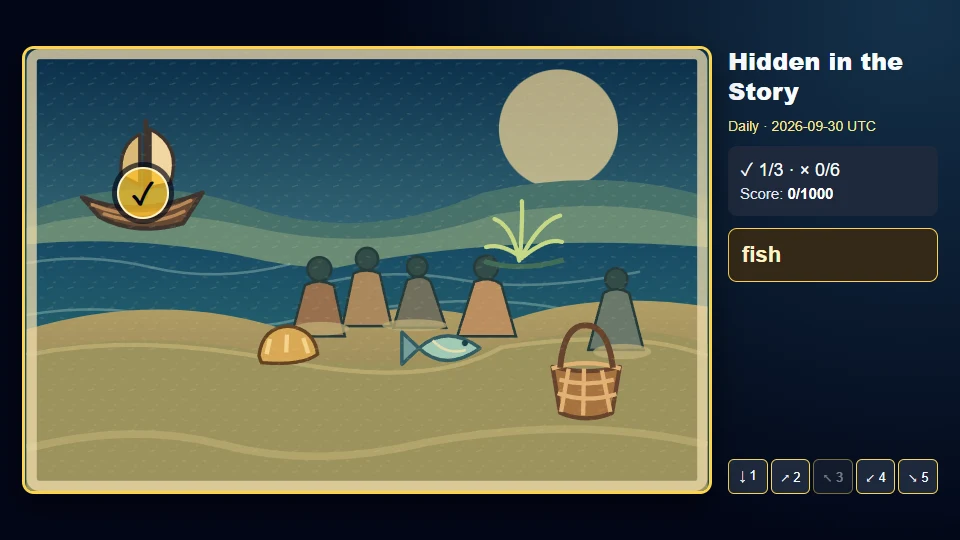
    Five passage-grounded object identities participate in the search, rather than appearing only in a decorative caption.

    Reading focus
    Recognize objects beside Mark 6 references without turning the task into a factual-count quiz.
    Estimated duration
    2-5 min. Editorial estimate, not observed; reading and discussion add time
    Source difficulty facet
    Beginner. Released difficulty facet, not measured usability
    Typed input required
    Buttons or selections; no free-text answer
    Play format
    Scene inspection
    Bible section
    Gospels
    Source-marked group suitability, not multiplayer
    Yes
    Session format
    One three-target search; afterward identify a detail in the passage that the picture alone cannot establish.
    Source and fiction boundaries
    Object placement is invented. Five loaves, two fish and twelve baskets are passage facts, not the game's target counts.
    Facilitator preparation
    Object placement is invented. Five loaves, two fish and twelve baskets are passage facts, not the game's target counts. Read the cited passage and separate the task from its biblical background. Scores do not measure understanding or faith. One operator on a shared screen; voluntary turns and discussion, not online multiplayer. Pre-read sensitive passages and allow passing.
  2. 2. Miracle Match

    Play

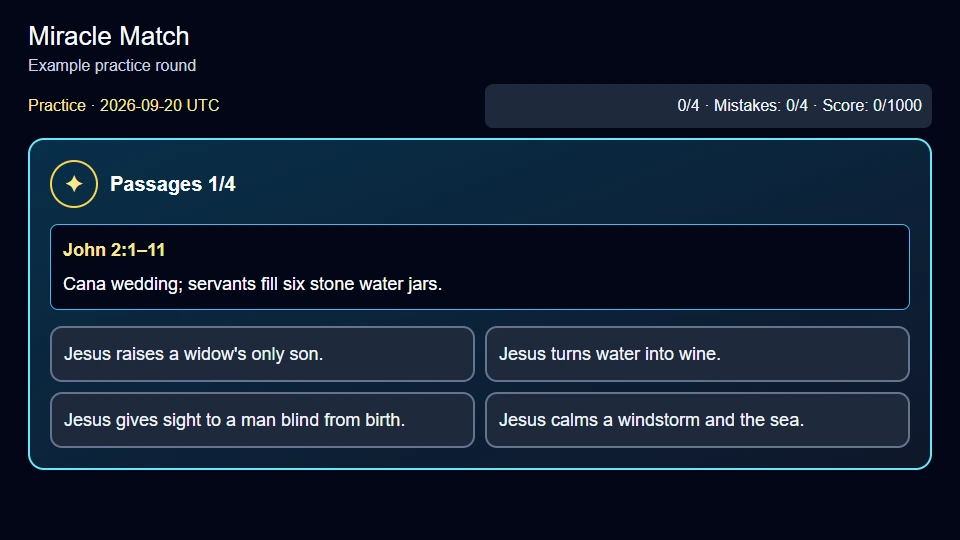
    All seven selectable accounts concern Jesus, and their specific contexts determine the match.

    Reading focus
    Recognize distinct Gospel miracle contexts and check the corresponding source account.
    Estimated duration
    3-7 min. Editorial estimate, not observed; reading and discussion add time
    Source difficulty facet
    Moderate. Released difficulty facet, not measured usability
    Typed input required
    Buttons or selections; no free-text answer
    Play format
    Questions
    Bible section
    Gospels
    Source-marked group suitability, not multiplayer
    Yes
    Session format
    Four account matches; read one cited context before comparing it with another account.
    Source and fiction boundaries
    Separate accounts remain separate, not a single dated miracle sequence. Public context clues are shorter than the fuller source notes.
    Facilitator preparation
    Separate accounts remain separate, not a single dated miracle sequence. Public context clues are shorter than the fuller source notes. Read the cited passage and separate the task from its biblical background. Scores do not measure understanding or faith. One operator on a shared screen; voluntary turns and discussion, not online multiplayer. Pre-read sensitive passages and allow passing.
  3. 3. Parable Paths

    Play

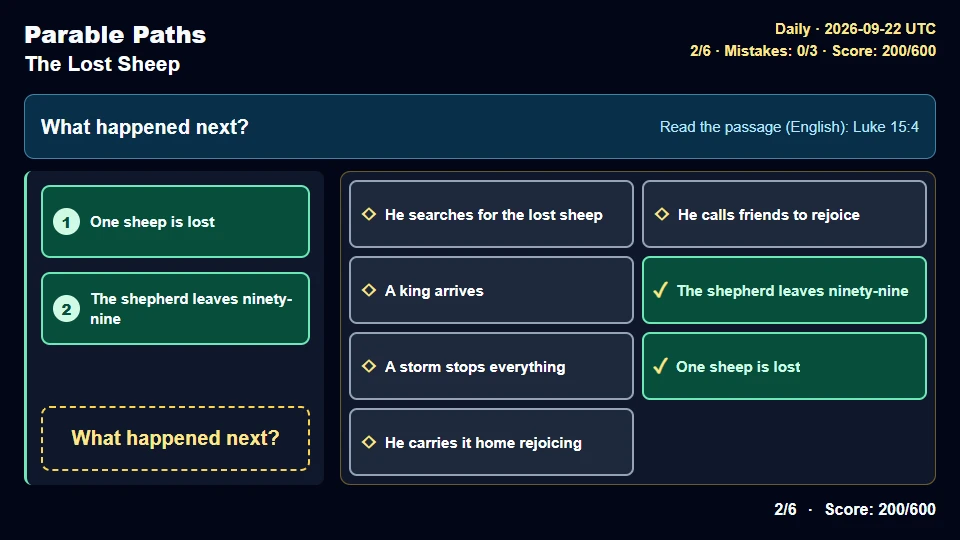
    The source's narrated steps and excerpt ending determine which choices are accepted.

    Reading focus
    Follow selected Good Samaritan, lost-sheep or lost-son excerpts while respecting their different scopes.
    Estimated duration
    3-7 min. Editorial estimate, not observed; reading and discussion add time
    Source difficulty facet
    Moderate. Released difficulty facet, not measured usability
    Typed input required
    Buttons or selections; no free-text answer
    Play format
    Route planning
    Bible section
    Gospels
    Source-marked group suitability, not multiplayer
    Yes
    Session format
    Six choices in one parable; continue reading beyond a selected excerpt before discussing the full teaching.
    Source and fiction boundaries
    Decoys are invented. The lost-son excerpt ends at Luke 15:24, before the elder brother's response; it does not cover the entire parable.
    Facilitator preparation
    Decoys are invented. The lost-son excerpt ends at Luke 15:24, before the elder brother's response; it does not cover the entire parable. Read the cited passage and separate the task from its biblical background. Scores do not measure understanding or faith. One operator on a shared screen; voluntary turns and discussion, not online multiplayer. Pre-read sensitive passages and allow passing.
  4. 4. Parable Puzzle Room

    Play

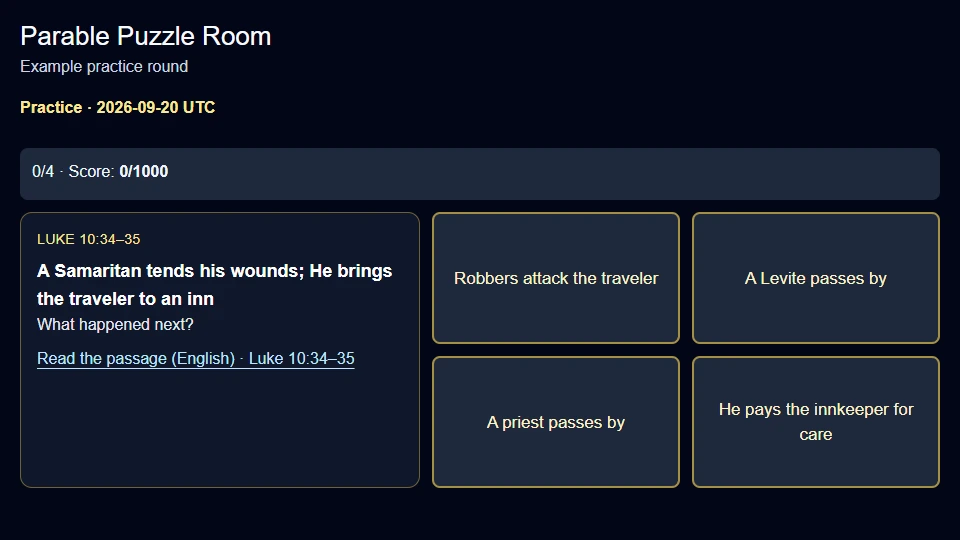
    All four tasks use details of the same cited Jesus parable rather than merely decorating a generic room puzzle.

    Reading focus
    Compare details of Luke 10:30–37 while separating the passage from room locks and pictograms.
    Estimated duration
    3-7 min. Editorial estimate, not observed; reading and discussion add time
    Source difficulty facet
    Moderate. Released difficulty facet, not measured usability
    Typed input required
    Buttons or selections; no free-text answer
    Play format
    Scene inspection
    Bible section
    Gospels
    Source-marked group suitability, not multiplayer
    Yes
    Session format
    Four questions; compare the shared Good Samaritan scope with Parable Paths rather than calling them unrelated subjects.
    Source and fiction boundaries
    Locks and room framing are invented, not a historical escape room. The passage does not identify the animal's species despite the ride pictogram.
    Facilitator preparation
    Locks and room framing are invented, not a historical escape room. The passage does not identify the animal's species despite the ride pictogram. Read the cited passage and separate the task from its biblical background. Scores do not measure understanding or faith. One operator on a shared screen; voluntary turns and discussion, not online multiplayer. Pre-read sensitive passages and allow passing.
  5. 5. Gospel Harmony

    Play

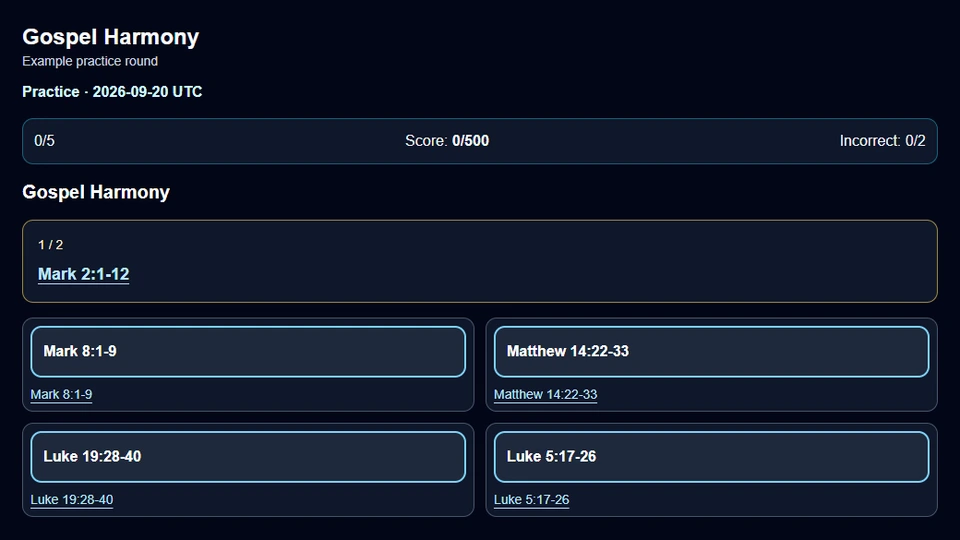
    Specific Gospel references in eight event groups determine the accepted pair.

    Reading focus
    Compare parallel account references and distinguish the feeding of five thousand from the feeding of four thousand.
    Estimated duration
    4-9 min. Editorial estimate, not observed; reading and discussion add time
    Source difficulty facet
    Moderate. Released difficulty facet, not measured usability
    Typed input required
    Buttons or selections; no free-text answer
    Play format
    Questions
    Bible section
    Gospels
    Source-marked group suitability, not multiplayer
    No
    Session format
    Five comparisons; discuss one shared event and one detail belonging to only one cited account.
    Source and fiction boundaries
    Grouping parallel accounts does not impose a single chronology or merge all details. The two feeding events remain separate groups.
    Facilitator preparation
    Grouping parallel accounts does not impose a single chronology or merge all details. The two feeding events remain separate groups. Read the cited passage and separate the task from its biblical background. Scores do not measure understanding or faith. One operator on a shared screen; voluntary turns and discussion, not online multiplayer. Pre-read sensitive passages and allow passing.
  6. 6. Pixel Parable

    Play

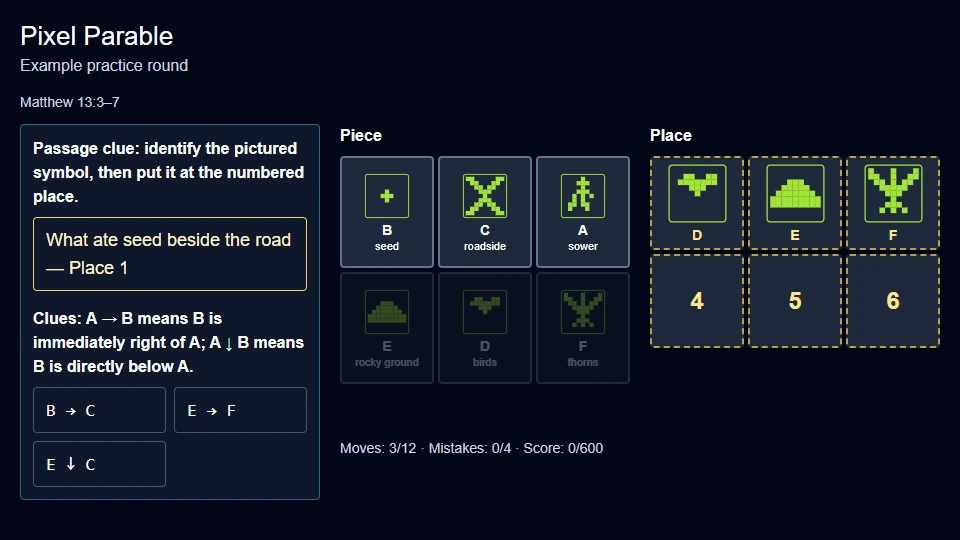
    A source fact is needed to make the layout unique; spatial clues alone are insufficient. All three possible scenes are Gospel parable excerpts.

    Reading focus
    Identify the role of the lamp or coin, birds or thorns, or sought and remaining sheep without treating a puzzle position as a theological interpretation.
    Estimated duration
    No completion timing collected; any displayed ranges are editorial estimates.
    Source difficulty facet
    Moderate. Released difficulty facet, not measured usability
    Typed input required
    Buttons or selections; no free-text answer
    Play format
    Scene inspection
    Bible section
    Gospels
    Source-marked group suitability, not multiplayer
    No
    Session format
    Answer the passage anchor first, then arrange the other tiles. With one shared-screen operator, separate the text-supported answer from the invented spatial clues; no multiplayer or observed classroom approval is claimed.
    Source and fiction boundaries
    Six icons, slot numbers and adjacency are invented artistic arrangements, not a portrait, event timeline, complete account or universal visual theology. One round samples one of three scenes; timing remains unmeasured.
    Facilitator preparation
    Six icons, slot numbers and adjacency are invented artistic arrangements, not a portrait, event timeline, complete account or universal visual theology. One round samples one of three scenes; timing remains unmeasured. Read the cited passage and separate the task from its biblical background. Scores do not measure understanding or faith. One operator on a shared screen; voluntary turns and discussion, not online multiplayer. Pre-read sensitive passages and allow passing.

Selection rationale

For readers age 13 and older choosing a focused Gospel task. Supplied object names can reduce recall demands; comparing references requires more reading. Neither approach certifies learning, spiritual maturity or the meaning of an entire teaching.

Choose one round, then leave separate time to read its cited passage. Shared-screen conversation is optional, with one operator and voluntary turns, not built-in multiplayer or classroom usability approval. Displayed ranges are editorial estimates, not observed completion times.

A Gospel object, account detail, narrated step, passage answer or parallel reference must participate in play.

Compare object recognition first, then account matching, narrated steps and passage questions, then cross-account references and source-led spatial reasoning. This is an editorial comparison, not Gospel chronology, popularity or measured difficulty.

No. Hidden in the Story, Miracle Match and Gospel Harmony overlap on feeding-five-thousand accounts. Parable Paths and Parable Puzzle Room share the Good Samaritan; Pixel Parable and Parable Paths both sample the lost sheep. Different mechanics can revisit the same source.

Choosing a game

  • Hidden in the Story asks for three objects in an imagined Mark scene. Use the equivalent labeled choices if image hotspots do not suit your input. The illustrated positions and three-target round are not historical placement or the passage's food quantities.
  • Miracle Match uses shorter public context clues to distinguish selected miracle accounts. Gospel Harmony instead pairs references to a shared event. Keep the five-thousand and four-thousand feedings separate, and compare accounts without merging every detail.
  • Parable Paths follows one of three Luke excerpts through six choices. The lost-son excerpt ends at verse 24, before the elder brother's response; continue reading before discussing the whole parable. Invented decoys are choices to reject, not extra biblical events.
  • Parable Puzzle Room concentrates four tasks on the Good Samaritan in Luke 10:30–37. Its room locks are fiction, and the passage does not identify the animal's species. Compare its scope with Parable Paths rather than treating the shared parable as two independent subjects.
  • Pixel Parable uses a detail from the lost coin, sower or lost sheep to anchor a six-icon layout. The fact is needed to make the solution unique; right, below and adjacency clues are the game's invention. One daily round samples one scene, not the whole Gospel catalog.

Do these games recreate Jesus' life or measure faith?

No. Artwork, rooms, decoys and spatial layouts are invented game frames. Passage details support specific tasks, not historical scene reconstruction, spiritual-worth ratings or proof of understanding.

Does six games mean six unrelated Bible subjects?

No. Hidden in the Story, Miracle Match and Gospel Harmony overlap on feeding-five-thousand accounts. Parable Paths and Parable Puzzle Room share the Good Samaritan; Pixel Parable and Parable Paths both sample the lost sheep. Different mechanics can revisit the same source.

All Bible games